
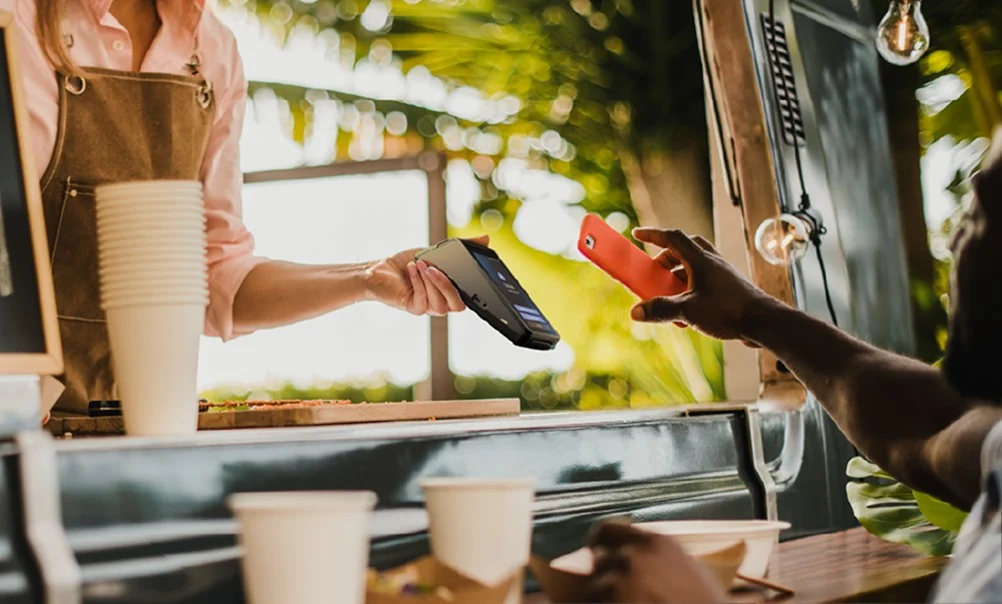
For a market stall or food truck, choose a card machine with reliable mobile coverage, enough battery for your trading day and fees that fit quiet months as well as busy ones. Compare the whole monthly cost, then check connection, receipts and agreement terms before choosing.
Here's what to look for, and how the pricing plays out for a mobile trader.
What matters most when you trade on the move
Its own connection
Some card readers have their own built-in SIM card and connect over mobile data. Others pair with your phone over Bluetooth and use your phone's signal. A reader that relies on your phone also relies on your phone's battery and data, so check how it connects before you buy, especially if you trade in fields, car parks or rural markets.
Check fixed charges in quiet months
Watch for monthly rental, subscription fees and minimum monthly charges. Minimum charges typically run from £20 to £40 a month depending on turnover [3]. If you only trade some weekends or in summer, a machine with no monthly machine cost avoids that rental charge in the weeks you don't trade. Ask what other charges apply too, so there are no surprises.
Fees on small sales
Many stall and food-truck sales are small: a coffee, a burger, a bunch of flowers. Some pricing adds a few pence to every payment, typically 1p to 3p [3]. On small sales that part matters more, so know your average sale before you compare.
Battery, receipts and the day itself
Ask how long the battery lasts on a busy day, whether it prints receipts or sends them by text or email, and how quickly the money reaches your bank. A machine that dies at 3pm on a festival Saturday is the most expensive one you can have.
The contactless limit
For most contactless cards, the limit is £100 [4]. Since March 2026, banks and payment providers with strong fraud controls can set their own contactless limits, although most are expected to keep their existing limits for now [6]. If a sale goes over a card's limit, the payment may need chip and PIN instead, or the customer can pay by phone where that's available [5]. Make sure your machine takes chip and PIN for bigger orders, like a family meal or a catering job.
What it costs: a busy month and a quiet month
Most well-known mobile readers charge a flat percentage. At the time of writing (November 2026), Square charges 1.75% for UK cards in person [1]. SumUp charges 1.69% on its pay-as-you-go plan, or offers a £19-a-month subscription with a 0.99% rate for eligible domestic consumer card payments, which it pitches at businesses taking £3,000 or more a month [2]. Corporate, premium and non-EEA cards do not qualify for that reduced consumer-card rate [2].
Example: a food truck takes £4,000 on card in a busy month across 500 payments (an average of £8), and £800 across 100 payments in a quiet month. Here's what each pricing shape costs in card fees, before other charges. The SumUp subscription calculation assumes every payment qualifies for its domestic consumer-card rate; premium, international and American Express cards can change the total [2].
| Pricing shape | Busy month (£4,000) | Quiet month (£800) |
|---|---|---|
| Flat 1.75% (Square's in-person rate) | £70.00 | £14.00 |
| Flat 1.69% (SumUp pay-as-you-go) | £67.60 | £13.52 |
| £19 a month plus 0.99% (SumUp subscription, eligible domestic consumer cards only) | £58.60 | £26.92 |
| 1.25% per payment, no authorisation fee, no monthly machine cost (Shift4 Solo) | £50.00 | £10.00 |
Notice how the SumUp subscription costs less than the Square and SumUp pay-as-you-go examples in the busy month but costs the most in the quiet one, because the monthly fee is due whether you trade or not. That's the pattern to watch for any plan with a monthly fee.
Your own numbers will be different. Your average sale, how many weeks you trade and your card mix all change the answer. Our café card-fee guide explains the effect of small payments. If you are starting out, see what a new business needs to apply for a card machine.
If you trade away from a stall too, such as at customers' homes or on jobs, our guide to taking card payments on the go compares phone readers, standalone machines and payment links.
Where Shift4 Solo fits
Solo is the TrustPOS option built for this kind of trading:
- A free card machine with no monthly machine cost.
- 1.25% per transaction, no authorisation fee.
- A built-in 4G SIM, so no Wi-Fi is needed, subject to coverage.
- Point-of-sale software on the machine itself: a menu of up to 50 items, plus manual payments and payment links for pre-orders or catering deposits.
- An 18-month agreement with free cancellation at any time. We confirm the notice and equipment-return steps before you apply.
For a new or mobile trader, built-in connectivity and no machine rental can be useful. Ask for the full pricing and cancellation terms for your planned start date, especially if your trading is seasonal.
Check the machine at your actual pitch
Check mobile reception where you will take payments, rather than relying on the signal outside your home. Ask which network the supplied SIM uses and what happens if reception is lost. Do not assume offline payments are supported.
Ask for the battery specification for the exact terminal, a suitable charging option and the receipt choices your customers need. A festival day can be longer than a normal shift; test the setup before your first busy event. Keep a backup way to take payment that you and your provider have agreed.
Before you choose: a quick checklist
- How does it connect? Built-in SIM, or does it rely on your phone?
- What does it cost in a month you don't trade? Look for monthly fees and minimum charges.
- What's your average sale? Check how per-payment pence affect it.
- Will the battery last your longest day?
- Does it take chip and PIN for sales over the contactless limit?
Sources
- Square pricing (UK), checked 5 November 2026
- SumUp pricing (UK), checked 5 November 2026; scope checked against SumUp Payments Plus FAQ
- Mobile Transaction: card machine charges explained, published 8 April 2025, checked 16 October 2026
- UK Finance: contactless payments, checked 16 October 2026
- UK Finance: contactless limit change FAQs, checked 16 October 2026
- FCA: greater flexibility to be given for setting future contactless limits, 19 December 2025, checked 16 October 2026
This guide is general information, not financial advice. Any saving depends on your current charges, card mix and final terms.